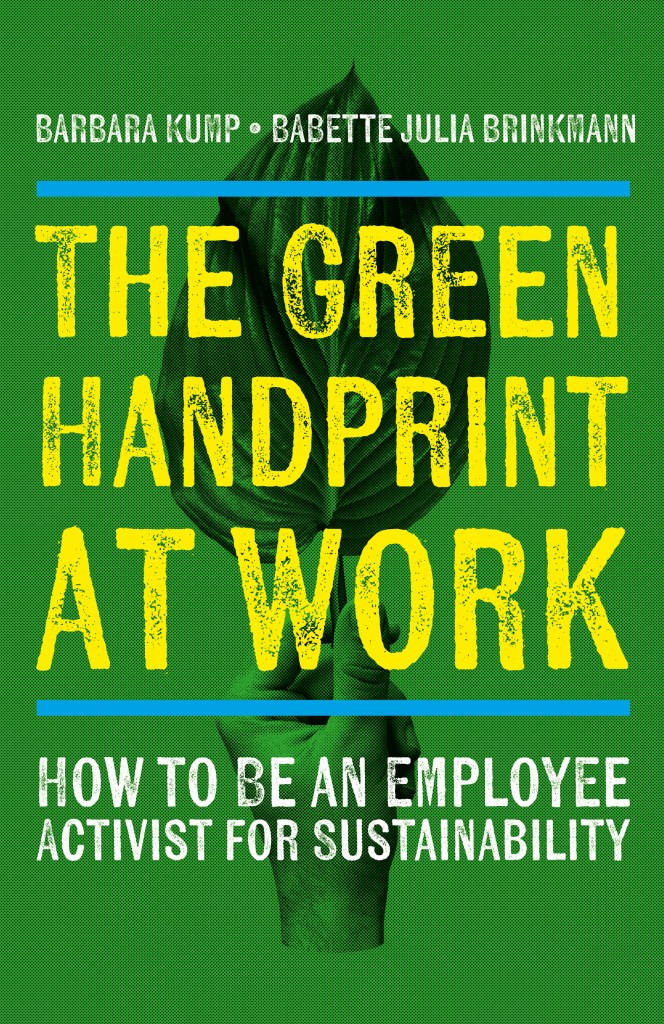
Together with my colleague Babette Brinkmann I have written “The green handprint at work: How to be an employee activist for sustainability“ (Bristol University Press) which aims to empower employees to change their workplaces from within.
Short Summary
Our future is being dismantled in real time. Ecological collapse, climate breakdown, rising inequalities – and at the heart of it all: business as usual. More and more employees are beginning to realise – sometimes with quiet unease, sometimes with outright fury – that the organisations they work for, and often even the tasks they perform each day, are part of the problem rather than the solution.
They ask themselves – and they have asked us – how to respond. The Green Handprint at Work is our answer. It is intended to guide those who want to leave a positive environmental impact at their workplace by becoming an employee activist: someone who cares deeply about the environment and wants to create change from within their organisation.
Whether it’s product design, HR, IT, or finance; whether social and care work, consulting or research – we’re all part of processes and decisions that matter. That means we can push for better practices, improve policies, question assumptions, and spark new ways of doing business, education or care.
The Green Handprint at Work offers tools, not just inspiration. It provides employee activists with insights into how power works and how change spreads. It covers theoretical foundations, hard-won lessons, and encouraging stories from people who sparked environmental action from within. Here are some of the most important takeaways:
- Build a team. You’ll go further with others. Find allies, share the load, and stay motivated. A group is harder to ignore than a lone voice.
- Know your stuff. Understand the issues, the solutions, and your company’s footprint. Speak the language of strategy, risk, and opportunity.
- Understand power. Change isn’t just about logic – it’s about influence. Learn how decisions are made, formally and informally.
- Pick your battles. You can’t fix everything at once. Choose high-impact, achievable goals. Early wins build credibility and momentum.
- Frame it wisely. Speak to what decision-makers care about – cost, innovation, reputation, compliance. Offer solutions, not just criticism.
- Be creative. There’s no single formula. Every workplace is different. Sometimes the way in is culture; sometimes it’s policy or process.
- Stick with it. Resistance is normal. Stay focused, adapt as needed, and keep going. Small, persistent actions can lead to big shifts.
- Look after yourself. This work can be rewarding – and exhausting. Rest is part of your strategy. You’re in it for the long haul.
The book is here to show that we don’t need to be in charge to make a change. We don’t need to be perfect. But we can act. Because if we act from within, even business as usual can be challenged and organisations can contribute to a just and sustainable future.
The Green Handprint at Work is based on research findings, interviews with more than 30 employee activists, and experiences from our own consulting and coaching practices.
Resources related to the book
Videos
- Presentation at Business Declares Knowledge Exchange on 19th of February 2026 (ca. 10 min plus discussion): Link to video (starting at min 3:45); blog article about the event (including transcript)
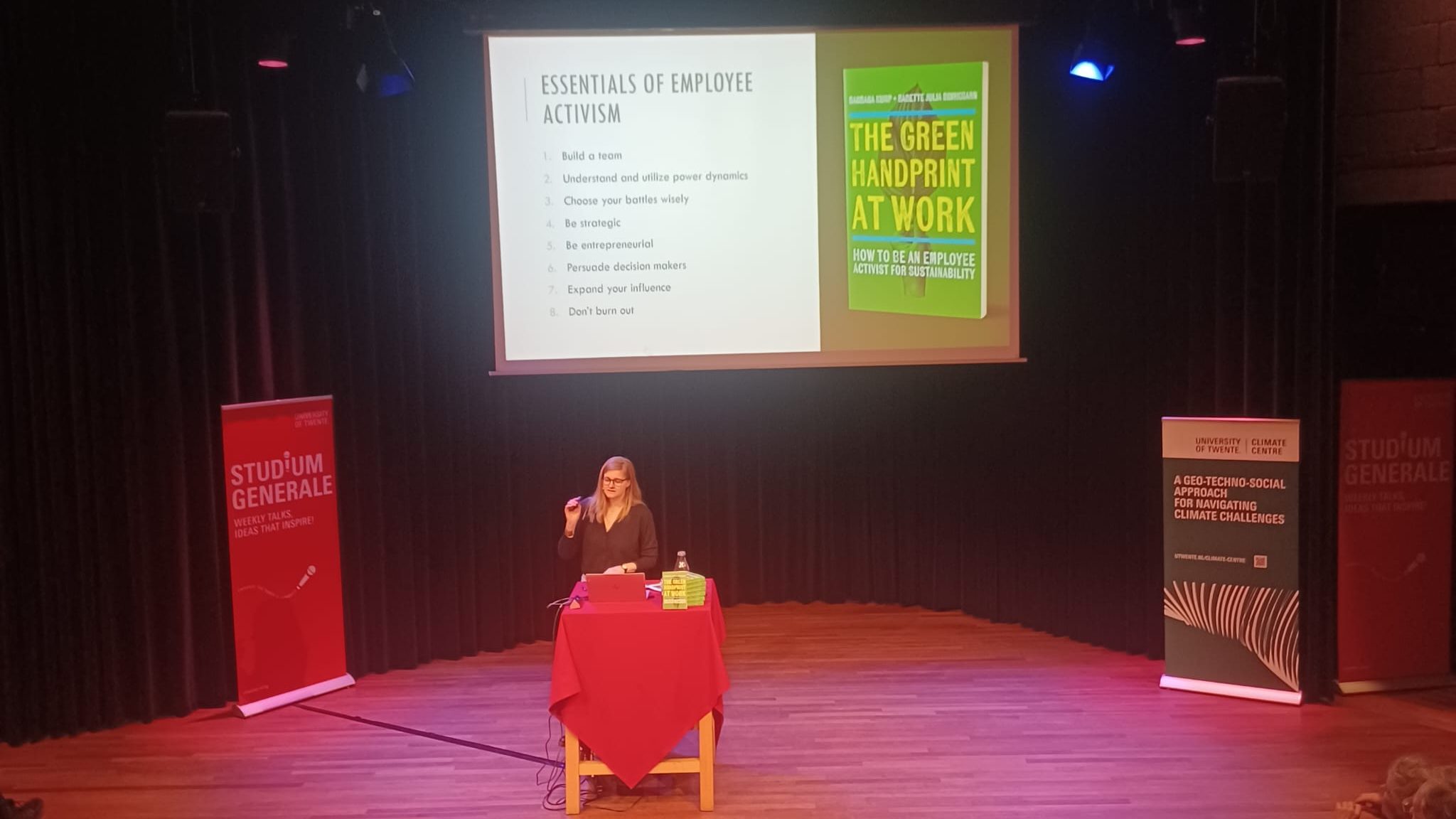
- Video of my talk in the Studium Generale lecture series at the University of Twente, 17th of March 2026 (ca. 45 min plus Q&A): Link to video
Podcasts
- Podcast episode on the Transforming Society Podcast (in English), 10th of March 2026 (ca. 30 min): Link to podcast
- Podcast episode with my co-author Babette Brinkmann on the Become Better podcast (in German), 25th March 2026 (ca. 1 hour): Link to podcast
Articles
- Brinkmann, B., Kump, B. (2025). „Verantwortung übernehmen“ – Wie Mitarbeitende Spielräume für Nachhaltigkeit nutzen. In: Geramanis, O., Hutmacher, S., Walser, L. (eds) Verspielte Freiheit in Organisationen. Springer Gabler, Wiesbaden.
- Brinkmann, B. J., & Kump, B. (2026). Den Worten Taten folgen lassen: Führungsaktivismus für Nachhaltigkeit. Zeitschrift f. Organisationsentwicklung, 16–20.
- Kump, B. (2026). Encouraging change from within — Even now?
- Kump, B. (2026). Change leaders for sustainability: Four spheres of influence
- Kump, B. (2026). “The Green Handprint at Work” – Three takeaway messages
- Article in April 2026 about the book in UTwente Science Stories
Events (Selection)
- Book Launch in London, 12th of March, 2026: LinkedIn post
- Presentation at Studium Generale, 17th of March, 2026, Enschede: LinkedIn post
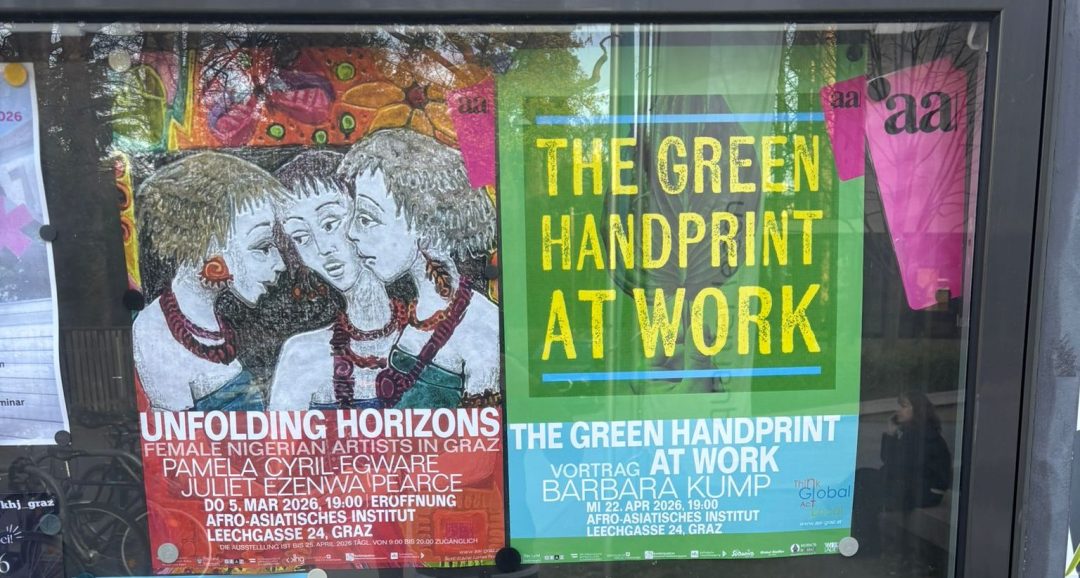
- Presentation and discussion at the Afro-Asiatisches Institut, 22nd of April, 2026, Graz: Link to the event
- Presentation and discussion at the Lustrum Event, University of Twente, 9th of May, 2026, Enschede: Link to the event
 Dr. Barbara Kump