In recent years, speaking up inside organizations has become riskier — yet perhaps more necessary. This article reflects on whether encouraging employee activism is still appropriate in a changing political and economic climate, and why acting from within may matter precisely when it feels hardest.
In a couple of days, on February 17, our book The Green Handprint at Work: How to be an Employee Activist for Sustainability (with Babette Brinkmann) will be out. In it, we encourage people at all ranks and in all industries who care about environmental issues to turn their concerns into action by trying to change their companies from within.
But is this really the right time, the right topic, the right message, given current political and societal developments around environmental issues?
Back in 2019, when I started working on Insider Social Change (the more neutral and scientifically grounded term for what we call Employee Activism in the book), mainly in teaching and executive education, there was a strong sense of momentum, almost a feeling of new beginnings. Fridays for Future was gaining global traction, tech workers in the US achieved several notable breakthroughs, and although COVID-19 slowed much of this down, many people felt that change was actually possible. They just needed the skills and support to make it happen.
This spirit was still present on that consequential night in November 2022, after my guest lecture on Employee Activism at Babette’s university in Cologne, when we decided to write the book. Our vision was simple: a book that could fit into the pocket of any employee who cares about sustainability and wants to take concrete steps to change their company from within.
Fast forward to November 2024, when we were — of all things — writing the final chapter on hope. Donald Trump had just been re-elected as U.S. president and quickly announced his intention to withdraw the United States from the Paris Agreement (for the second time!). At the same time, several prominent tech leaders signaled a pragmatic willingness to align with the new administration. The broader conditions for employees working toward climate and other societal causes were clearly shifting.
Global economic uncertainty and the rapid rise of AI, which began to threaten jobs, especially in tech, made inconvenient voices easier to replace. Speaking up increasingly came with risks: warnings, subtle repercussions, and, in some cases, layoffs. And this is still what we hear today. When we talk to people trying to create change from within their organizations, many tell us it has become harder — and for some, more dangerous — to do so.
Due to this changing situation, we have been grappling with two difficult, interrelated questions:
- Is this really the right moment to encourage employees to push for change from within their organizations?
- How much change can employees realistically still create from the inside, given the increasing pressure they are facing?
Here are some reflections on both of them.
Perhaps now more than ever
Beyond the urgency of the environmental crisis — and the fact that we simply do not have time to lose — this may be precisely the moment when many different actors need to contribute to solving it. In the words of Rebecca Solnit (2016), there “is a role for everyone in this critical moment to change things for the better, and given the stakes, it is perhaps the most important work any of us can do.”
People appear to be aware of the urgency and willing to do something about it. For example, a recent representative study suggests that 86 percent of the global population endorse pro-climate social norms and 89 percent demand stronger political action (Andre et al., 2024). Nevertheless, when speaking to people about environmental action, most refer to ways of reducing their personal carbon footprint, for instance, by flying less or adopting a vegan diet. The concept of the carbon footprint, popularized in part through campaigns by the fossil fuel company BP, has contributed to shifting much of the perceived responsibility for climate action into private life. The workplace or one’s job role is therefore often not even considered a site of climate action.
Even when it is, the sheer magnitude of the problem can leave people feeling powerless, and many place responsibility for their company’s impact solely on the organization itself. From there, realizing that their company (and thus they themselves) are part of the problem rather than the solution often triggers a first impulse: to leave. In recent years, many have chosen to quit their jobs rather than trying to create change from within. This phenomenon has appeared in the media under the label climate quitting. While leaving can send a signal to employers, especially when the reasons are made explicit, its catalytic potential inside the organization is lost, as lasting organizational change rarely happens without people acting from within.
At the same time, many of the conventional routes for change feel slow or blocked: political processes are contested, regulation takes years, and public pressure often diffuses before it translates into concrete organizational practices. In such situations, attention shifts to the arenas where everyday decisions are actually made: inside organizations. Precisely when large-scale change appears distant, smaller internal interventions can become comparatively more influential. Changing one’s own organization — for example in the products it develops or the investments it makes — can therefore become a powerful lever for broader systemic change.
While many people do not immediately see that changing their company from within is feasible, and they lack the knowledge and skills to initiate it, it may well be worth a try, especially for those who are considering leaving anyway. The book is meant as a source of inspiration for those who doubt whether their actions matter, and as a companion for those who dare to take action.
Change from within can work
Another core question we often hear is: can I really make a difference within my organization? The answer is: more often than people expect. In the book we share many examples. These include small initiatives, like Ben*, a student employee who gradually introduced environmental data into presentations he prepared, as well as larger ones, such as Anne, who helped roll out sustainability trainings for 2,500 employees in her production company. The book also presents stories from people who have become well known for their activism, such as Maren Costa (Amazon), Drew Wilkinson and Holly Alpine (Microsoft), and Zoe Samuel (Google). But most experiences we share come from “ordinary” employees who decided to act within their everyday roles. Together, they show that change is often incremental, and that more is possible than many initially assume.
In an interview on the Inevitable podcast in February 2025, Eugene Kirpichov, former Google employee and co-founder of workonclimate.org, calls for “people who don’t wait for somebody to ask them to do things, but people who go and push for change that would not have happened if not for them.” He calls them climate leaders — but that is essentially what we mean by employee activism. The key point is that each of us, in any role and any industry, can make changes — small or large — that would not have happened otherwise.
Importantly, encouraging employee activism does not mean shifting responsibility from institutions to individuals. Companies, governments, and regulators remain accountable for systemic change, and not everyone can safely speak up in their workplace. In some contexts, silence is rational and self-protection legitimate.
The intention of our book is therefore not to demand courage, but to support it where it already exists. Some employees will choose to leave, others to comply, and others to act. Our aim is simply to make the last option more informed and less lonely — by offering language, strategies, and examples.
The challenges ahead will need to be tackled from many angles, with many people contributing in different ways. Precisely because external change is slow and organizational pressures have increased, insider action remains an important lever where it is possible.
To make change from within viable, people need both the courage and the tools to try — and this is the role we hope the book can play.
* all names are pseudonyms, the same we are using in the book.
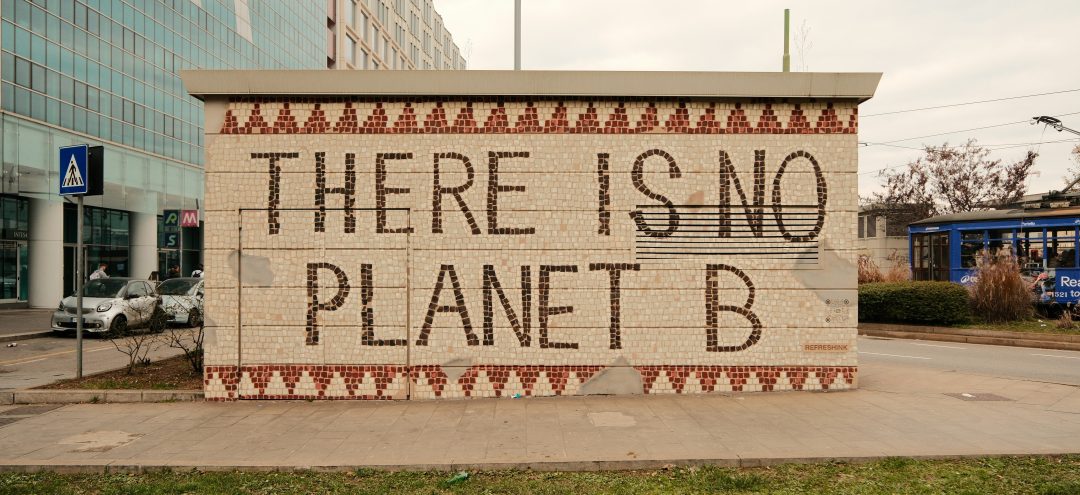
Photo by Claudio Schwarz on Unsplash
References
Andre, P., Boneva, T., Chopra, F., & Falk, A. (2024). Globally representative evidence on the actual and perceived support for climate action. Nature Climate Change, 14(3), 253–259.
Kump, B., & Brinkmann, B. J. (2026). The Green Handprint at Work: How to Be an Employee Activist for Sustainability. Bristol University Press.
Meadows, D. (2000). Chicken Little, Cassandra, and the real wolf: so many ways to think about the future. Wild Earth, 9(4), 24-29.
Solnit, R. (2016). Hope In The Dark: Untold Histories, Wild Possibilities. Canongate Books.

 Dr. Barbara Kump