
Where can leaders actually make a difference for sustainability? This article presents a simple model of how influence unfolds from personal conduct to team decisions, organizational change, and even industry-wide action.
In 2022, I was asked to develop a Masterclass for Sustainable Leadership for the Glacier Climate Academy. Since then, I have given many talks on the topic (for instance, a guest lecture at Vienna University of Applied Sciences), and in our new Leadership for the Future Program.
Leaders who care about sustainability often wonder where their influence realistically begins and ends. Over the years, I have developed a small practical model, which Babette Brinkmann and I enriched with insights from leadership interviews and recently presented in a German magazine (Brinkmann & Kump, 2026).
The model assumes that leaders operate within different, nested spheres of influence, starting with their own behavior, extending to their team, the wider organization, and sometimes even beyond the organization into the broader industry and society. Each circle offers different possibilities for sustainable leadership.
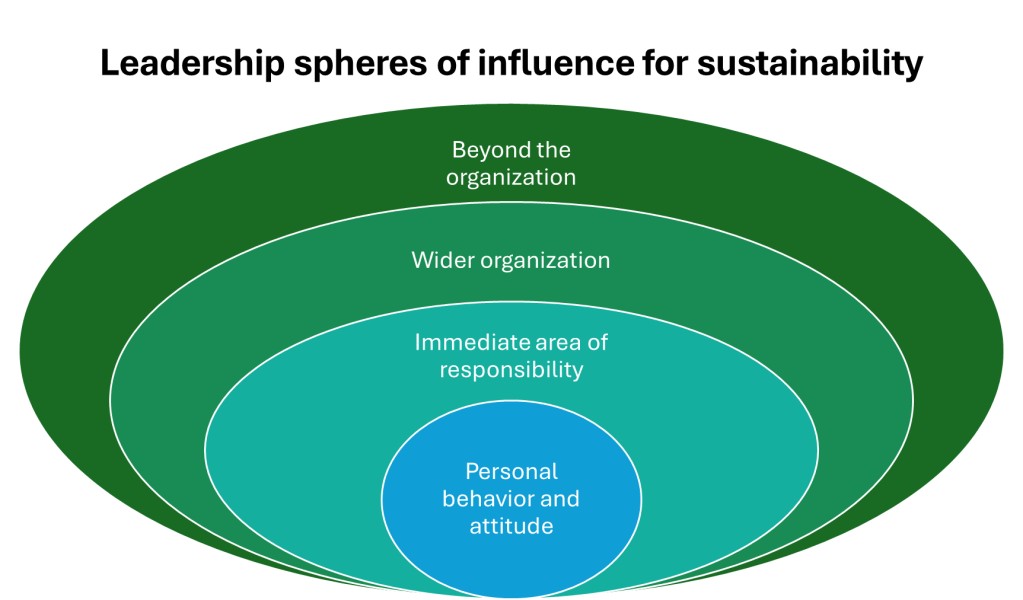
1. Personal behavior and attitude
The innermost sphere of influence is how leaders show up in their organization. This is partly about visible behavior. People watch leaders closely: they serve as models for what is considered acceptable and desirable. What they do becomes part of the organization’s norms. By demonstrating seriousness about sustainability in everyday conduct — travel choices, consumption habits, small daily decisions — leaders can influence those around them. Personal example therefore functions less through direct environmental impact and more as permission: it signals that sustainability values may be enacted without sanction and are even legitimate.
However, it is not only about behavior but also about inner attitude. In the preface to Earth for All, Christiana Figueres writes: “Large-scale change is surprisingly personal. It starts with […] what we prioritize, what we are willing to stand up for, and how we decide to show up in the world” (Dixson-Declève et al., 2022). Showing authentic care for sustainability in how leaders speak, act, and make decisions can have a significant effect on team members.
2. Immediate area of responsibility
The next sphere is the leader’s own domain, the place where decisions can actually be made. For instance, HR managers shape staffing practices, heads of procurement influence purchasing choices, and product managers define specifications. Leadership for sustainability therefore often begins with prioritizing sustainability within these everyday decisions wherever possible.
Depending on their role, leaders will face constraints — most commonly cost considerations. Yet while some targets and boundary conditions are fixed, organizations typically contain grey areas where rules are not fully specified. Within these spaces leaders can cautiously expand what becomes possible: piloting projects and testing practices that might otherwise not emerge.
Another avenue lies in negotiating resources for sustainability within their domain of influence. Most organizations today publicly commit to sustainability goals, which provides a basis for action. Leaders can treat such commitments not as symbolic statements but as operational mandates: If this were taken seriously, what would have to change in our processes, budgets, or targets?
Finally, leaders can encourage their teams to explore sustainable solutions and support them by opening doors, protecting initiatives, and creating temporary room for experimentation.
3. Wider organization
Beyond their immediate area of responsibility, leaders can also influence the organization as a whole. This is, in many ways, the core idea behind our book The Green Handprint at Work: How to be an Employee Activist for Sustainability (Kump & Brinkmann, 2026). Compared to other employees, they often have greater visibility and access to decision arenas. They can identify areas in need of change — products, processes, infrastructure, or investments — and begin to mobilize attention around them. By teaming up with colleagues, sometimes across departments, they can form networks that gradually influence strategy, structures, and organizational culture.
Such influence typically depends on communication. Raising awareness and building support rarely happens through facts alone; it requires framing the issue in ways that resonate with different audiences. This often involves persuasion and what is sometimes called “issue selling”: speaking the language of the respective decision arena. Finance departments respond to risk and cost, HR to retention, operations to efficiency. Sustainability becomes actionable when it is translated into the concerns that matter to those involved.
In practice, change leadership often begins with smaller initiatives — for example waste management practices or cafeteria options — that allow the organization to experiment and learn. Over time, such initiatives create experience, reveal resistance, and open space for more substantial change. The best strategy here usually is to be pragmatic and work incrementally with whatever opportunity presents itself, while keeping the broader sustainability objective in view (Heucher et al., 2024).
4. Beyond the organization
Leaders may also exert influence beyond the boundaries of their own organization. At this stage, leadership involves engaging in productive dialogues about sustainability initiatives across organizations — with competitors, suppliers, customers, and NGOs (Ortiz-Avram et al., 2025). Such conversations may focus on collaboration needs, the design of joint initiatives, or the practical implementation of shared standards. Engagement with NGOs, for example, can also involve discussions about regulatory frameworks and how they might evolve.
Organizations sooner or later encounter limits they cannot address alone, such as regulation, industry standards, or competitive dynamics. Here leadership requires collective action (Riegler et al., 2023). People may therefore participate in professional networks, associations, or multi-stakeholder initiatives to establish common standards and a level playing field. These efforts often prepare the ground for public commitments later endorsed by top executives. Change across industries rarely begins at the very top; rather, it accumulates through coordinated initiatives across levels.
A pragmatic view of leadership for sustainability
Leadership for sustainability does not require heroic transformation. It begins with becoming aware of the choices one has — in one’s own conduct, in everyday decisions, in shaping strategies, structures, and culture, and in exploring possibilities for change beyond the organization.
Leaders serve as role models. They influence budgets, priorities, and narratives. Each decision subtly shifts what becomes normal and thinkable. In this sense, leadership means making use of the possible while gradually expanding its boundaries — or, like workonclimate.org co-founder Eugene Kirpichov puts it, pushing for change toward sustainability that would not have happened without them.
References
Brinkmann, B. J., & Kump, B. (2026). Den Worten Taten folgen lassen: Führungsaktivismus für Nachhaltigkeit. Zeitschrift Für Organisationsentwicklung, 16–20.
Dixson-Declève, S., Gaffney, O., & Ghosh, J. (2022). Earth for All: A Survival Guide for Humanity. New Society Publishers.
Heucher, K., Alt, E., Soderstrom, S., Scully, M., & Glavas, A. (2024). Catalyzing action on social and environmental challenges: An integrative review of insider social change agents. Academy of Management Annals, 18(1), 295–347.
Kump, B., & Brinkmann, B. J. (2026). The Green Handprint at Work: How to Be an Employee Activist for Sustainability. Bristol University Press.
Ortiz‐Avram, D., Andraos, M., Salomon, K., & Kump, B. (2025). Unpacking productive dialogues as building blocks of dynamic capabilities for sustainability‐oriented innovation. Business Strategy and the Environment, 34, 10457–10473.
Riegler, M., Burton, A. M., Scholz, M., & de Melo, K. (2023). Why companies team up for sustainable development: Antecedents of company engagement in business partnerships for sustainability. Business Strategy and the Environment, 32(7), 4767–4781.

 Dr. Barbara Kump