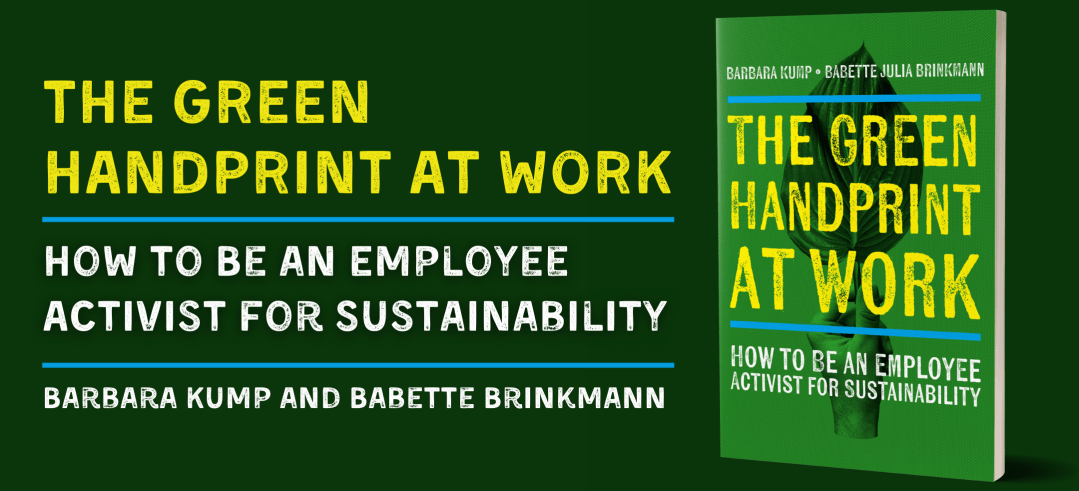
On February 17, 2026, our book “The Green handprint at work: How to be an employee activist for sustainability” (co-authored with Babette Brinkmann) came out. Here are three key takeaway messages.
How I came to write this book
I would like to start with a short personal story about myself—how I came to working on sustainability, and ultimately to writing this book. I grew up in a suburb of Graz, Austria, with a big garden. There were chickens, there were all kinds of plants: vegetables, fruits, flowers. I really grew up very close to nature, and nature was always very dear to my heart as a child. And that connection stayed with me as I grew up. I was environmentally conscious in my private life. I cared about what I ate, how I travelled, the clothes I wore, and so forth. It was an important part of who I was as a private person.
But in my work as a business researcher, I was studying organisational change processes. I was working with companies that pollute, sometimes helping them become more efficient and things like that. Around 2019, I started to realise that I had never really connected my work life with my private values. And I began asking myself: how could I overlook that? How could I overlook my own work when thinking about my environmental impact?
At that point I made a decision. Either I would find a way to dedicate my work to environmental sustainability, or I would leave academia and look for another way to contribute. Today I would say that about 90% of my research and teaching is dedicated to sustainability, so I’m quite happy with how that unfolded. And the book is part of that journey.
My research focuses mostly on organisational processes. And that matters, because most environmental harm happens in business organisations or in the context of business organisations. If we talk about emissions, waste, water use, deforestation—these things largely happen through businesses. Not because businesses are necessarily bad—that is not the message here—but because that is where these activities take place. So if we want a more sustainable world, businesses need to become more sustainable.
Yet when I speak to people who are not CEOs of large corporations but ordinary employees—sometimes even leaders—they often think that their personal footprint is the most important area where they can make a difference. Just like I did. We focus on our own travel, our own food, our own clothes.
And of course we know that these things matter. Changing light bulbs has a relatively small impact on our carbon footprint. Eating a plant-based diet can have a bigger impact. Having one child fewer would have a very large impact. But when it comes to businesses, many people think: there is not much I can do. Managers have to change. Policymakers have to change. I personally have no role to play.
What Babette and I wanted to do with this book is to challenge that assumption—because it simply isn’t true.
Three key takeaway messages
The book has three key takeaway messages. The first is: your handprint matters. Of course our footprint matters too—the way we eat, travel, and consume. But what is at least as important, and we would argue often even more important, is the contribution you can make to sustainability through your decisions and actions at work and in your communities. That is not about the footprint you leave. It is about the handprint you create by influencing decisions and shaping what happens around you.
Indeed, many sustainability initiatives inside companies are not initially driven by top management. Often they begin with employees and middle managers who champion these issues internally. Over time, senior leadership adopts the idea, legitimises it, and scales it once internal momentum has formed. So employees play a crucial role in building that momentum.
The second message is that you can make a difference from wherever you are. In researching for the book, we spoke with many people—project managers, paralegals, engineers, HR professionals—who had very inspiring stories about initiating change. Some of these were small changes, others were very large ones. But what we learned is that it matters less where you sit in the organisation than you might think. You can often find ways to initiate change from wherever you are.
The third message is: What is important is to take action. That is also why, after much discussion, we decided to keep the term employee activism. Because ultimately, change requires people to act. Much of this work involves laying invisible groundwork. Babette and I are both big fans of Rebecca Solnit, who writes beautifully about this in her book Hope in the Dark. She uses the metaphor of mushrooms. When you walk through a forest and suddenly see mushrooms appear, it looks as if they came out of nowhere. But in reality, a vast network of mycelium has been growing underground for a long time. And that is very similar to employee activism. Much of the work happens underground—spreading ideas, building networks, connecting people—so that when the right moment arrives, something new can emerge.
In the book we therefore offer many practical ideas for how to create change from within organisations. For example, we emphasise the importance of not acting alone, but building alliances and teams. We discuss how to understand and use power dynamics—both formal and informal. We encourage people to choose their battles carefully: whether to focus on products and services, or on internal infrastructure, depending on where the biggest leverage lies. We also highlight the importance of being strategic, for example by linking sustainability initiatives to existing company strategies—and of being entrepreneurial: seizing opportunities when they arise, but also creating opportunities yourself. We dedicate a full chapter to persuading decision-makers, because at some point you will need to convince others to support your ideas. We also discuss ways of expanding your influence by growing your movement inside the organisation, or, if people feel comfortable with it, sometimes by applying external pressure, such as organising collective action. And finally, we talk about something that is extremely important: not burning out. This work requires energy, persistence, and emotional resilience, especially when setbacks occur. So taking care of yourself and sustaining your motivation is essential.
Let me end by summarizing the main takeaways: We believe that our handprints matter more than our footprints. We can make a difference from wherever we are—especially in the organisations and communities we are part of.
And, who knows? By leaving green a green handprint at our workplaces, we might eventually change the world, one organisation at a time.
This is a slightly polished version of a talk I gave on February 19, 2026 for a Knowledge Exchange Event of the NGO Business Declares. Here is the link to the video of the event: https://www.youtube.com/watch?v=xEZnASQOwxY
Kump, B., & Brinkmann, B. J. (2026). The Green Handprint at Work: How to Be an Employee Activist for Sustainability. Bristol University Press. https://bristoluniversitypress.co.uk/professional-business/the-green-handprint-at-work

 Dr. Barbara Kump