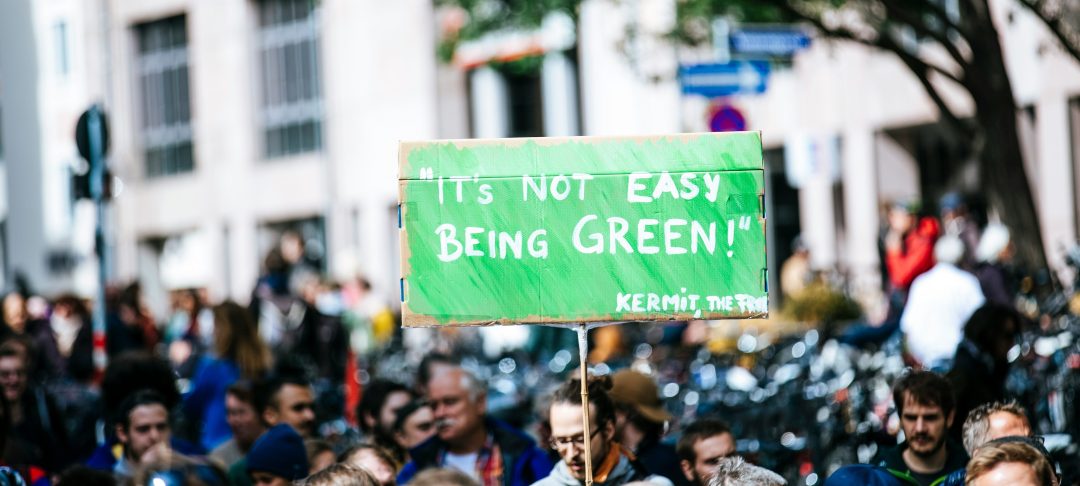
What does it really take to become a climate leader? In this post I suggest that beyond strategies and business cases, it requires the inner work of aligning our actions with what truly matters, especially when doing so comes at a personal cost.
Over the past couple of months, I have been thinking a lot about change leadership in the context of environmental sustainability and climate change. Babette Brinkmann and I recently published our book The Green Handprint at Work that encourages people at all ranks in their organisations to become employee activists for sustainability, i.e. to step up and take action on environmental issues. In essence, we are trying to support them in becoming what Eugene Kirpichov from Work on Climate has called “climate leaders”: people who don’t wait for somebody to ask them to act, but who push for change that would not have happened otherwise.
For me, the notion of climate leadership is strongly related to what leadership expert Paul T. Thomas wrote in a recent LinkedIn post: “It is a risky social act that appears when a human being decides to put something more important than their own comfort on the line.” In the case of climate leadership, this “something more important” is the environment, more precisely, the reduction or prevention of environmental damage, or in some cases the restoration of already degraded ecosystems. People rarely become climate leaders for personal gain or career advancement. They do so because they see environmental issues as among the most pressing challenges of our time and feel compelled to contribute.
Climate leadership is about speaking up about environmental problems and trying to change the current course of action. While we may make important progress by framing sustainability as a business case, sustained climate leadership ultimately means challenging dominant narratives of growth and profit maximisation—the holy grails of most business organisations. In practice, this often means risking one’s career: confronting superiors, redirecting time and resources, or questioning taken-for-granted priorities.
To give an example from my own context as an Associate Professor for Business & Sustainability at a research university: becoming a climate could entail, for instance, challenging existing curricula (can we teach business students degrowth?), questioning established collaborations (should we accept research funding from fossil fuel companies?), or working with stakeholders (e.g. training employee activists to change their companies from within), potentially to an extent that may frustrate supervisors, deans, and programme directors. More importantly, these activities require taking away resources from pursuing conventional performance outcomes such as journal publications or prestigious grants. The latter are precisely the metrics that matter in promotion decisions. Climate leadership, for me, could therefore mean risking my career progression within my university and within the academic system more broadly.
Echoing these challenges, Paul T. Thomas writes that decisive moments of leadership are “about whether someone will risk status, income, belonging, or career to name what everyone else is carefully ignoring.” That certainly sounds noble—and might even earn us some likes and support on LinkedIn. Yet, in practice, it is hard. In my case, it is difficult to resist the expectations of career committees, the social norms and peer pressure to “produce scientific outputs,” and instead consistently act as a climate leader. In business organisations, such pressures are often even more immediate, tied to performance targets and job security.
How, then, can we find the strength to act in these ways? How can we resist not only formal reward systems, but also the subtle expectations of friends and family when their ideas of success and “a good life” diverge from our own? How can we overcome the pull of conventional success, especially when alternative paths are uncertain and recognition is far from guaranteed?
The crucial part is to connect deeply to what matters to us and what is worth fighting for, even in the face of potential personal drawbacks or career risks. Rather than pursuing external goals, it is about finding this “inner core” and using it as a compass to guide our decisions that shape our contribution to environmental issues. While this path does not necessarily have to be detrimental, and some of us may even build new careers around it, in many cases, it will be costly not to take the straight route to conventional success.
Over time, I have come to understand that finding the strength to pursue this path—and to show leadership in the face of potential personal drawbacks—requires serious inner work. By inner work, I mean the ongoing practice of recognising how deeply our sense of worth is tied to external validation and how this very dependency keeps us aligned with the systems we may actually want to change. It is about learning to loosen that grip and connecting to one’s values not just intellectually, but in a way that actually holds when things become uncomfortable.
And uncomfortable it is. This kind of work often brings us face to face with parts of ourselves we would rather avoid: the fear of not being good enough, the desire to be seen and acknowledged by our peers, the anxiety of falling behind, or the disappointment of our mentors when we step off familiar paths. These are not just personal quirks. They are reinforced by a system that constantly nudges us back onto what often feels like a capitalistic hamster wheel: more output, more recognition, more status. Without doing this inner work, without confronting these unpleasant emotions and finding ways to feel good about ourselves even when we do not meet established performance metrics, it becomes very difficult to sustain climate leadership over time.
And this work is never finished. It is an ongoing practice, because it is so easy to get lured back into the “ego game” of career, status, and conventional success. In my personal development journey over the past two and a half decades, I have been confronting these dynamics in a thousand ways, and meditating for more than 10 years has helped me recognise (and sometimes change) my old patterns and reactions. Still, when I attend large conferences in our field, I feel the pull immediately: I want to publish those papers, give those keynotes, secure those grants—and other things, the educational changes, the practice-oriented projects, the environmental initiatives I want to start at my university, quietly fade into the background. Last time, after a large management research conference, it took me several weeks to shake of that desire, feel at peace again with my current output, and fully reconnect with what actually matters to me: contributing to sustainability transitions in our society through my research and teaching.
So, perhaps the real challenge of climate leadership is not whether we are willing to speak up and take action but whether we are willing to confront the parts of ourselves that make deviating from traditional career paths so difficult. Because as long as our sense of worth remains tightly tied to the very systems we are trying to change, stepping out of line will continue to feel like too much of a risk.
Photo by Markus Spiske on Unsplash

 Dr. Barbara Kump